
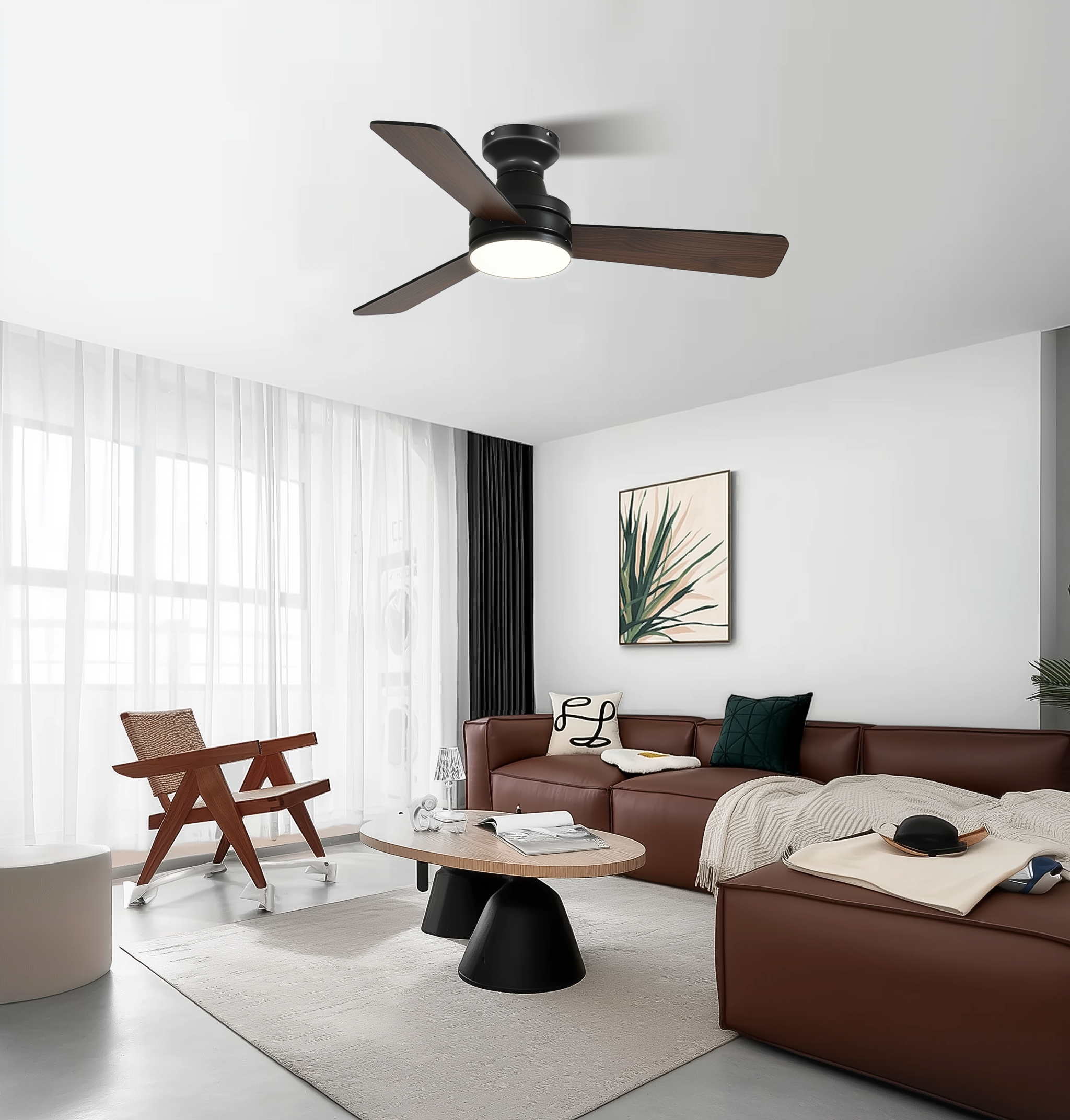
The persistent problem: form versus function in the bathroom
Many designers and homeowners confront a single, practical conflict: how to integrate a visually assertive ventilation fixture without compromising moisture control or acoustic comfort. The question is not merely aesthetic; it is technical. A decorative solution must still satisfy minimum ventilation rates and lighting requirements. Early in the specification process it is therefore prudent to test options such as a large ceiling fan with light against the room’s required airflow, mounting constraints, and the desired visual language.

Why it matters: health, codes, and measurable outcomes
Insufficient ventilation invites elevated relative humidity and consequent mould risk; industry guidance such as ASHRAE 62.2 and regional regulations (for example, California Title 24) emphasize mechanical extraction in wet rooms. The practitioner must therefore balance three measurable variables: CFM (airflow), Sones (acoustic rating), and lumen output of integrated lighting. These parameters are not optional — they determine compliance and occupant comfort. In other words, an attractive grille that delivers only a fraction of required CFM is a liability, not an asset.
Translating décor intent into technical requirements
Begin by defining functional targets, then select form to match. A concise workflow:
- Quantify required CFM based on room volume and local code.
- Set acoustic tolerance in Sones appropriate to the space (closer to 1–2 Sones for primary bathrooms; higher for utility-only rooms).
- Decide lamp type and CRI needs for the vanity and ambient zones.
When a statement fixture is desired, specify whether the fan will be ducted or ductless, and whether light integration will be LED retrofit or factory-integrated. This logic prevents last-minute compromises that cause either poor performance or aesthetic mismatch. If remote control and multi-speed operation are requirements, consider models marketed as large ceiling fans with lights and remote control, which often combine higher CFM with programmable light scenes and motorised speed control.
Material and mounting choices that preserve design intent
Material finish and grille geometry communicate style — minimal perforations read contemporary, while decorative cast elements read traditional. Crucially, the mounting method (recessed, semi-recessed, surface-mounted) will affect perceived scale and shadow, and may alter acoustic performance because of cavity coupling and ducting path. Designers should therefore request manufacturer data on backdraft dampers, duct diameter impact, and recommended clearances. A common oversight is to prioritize grille finish while ignoring duct routing — the result is a beautiful grille with inadequate extraction due to excessive bends or undersized ducting.

Practical selection checklist
Use this checklist at the specification stage to reduce iteration on site:
- Confirm required CFM and select a fan/fixture that delivers that CFM at installed static pressure.
- Specify Sones target; ask for certified sound curves at multiple speeds.
- Determine lighting requirements: lumen output, CRI, dimmability, and colour temperature.
- Verify ducting plan and backdraft prevention; prefer rigid duct for reduced turbulence where possible.
- Assess motor type (ECM motors offer improved efficiency and quieter operation) and service access.
Common mistakes and remedial strategies
Professionals frequently commit three errors: underestimating static pressure introduced by long duct runs, accepting vendor noise claims without on-site verification, and choosing integrated lighting that complicates maintenance. To fix these, model expected static pressure with the planned ducting, request in-situ sound measurements or reliable Sones data, and prefer modular luminaires that allow lamp replacement without full fixture removal — this simplifies future servicing. — It is simple oversight that often creates the largest regret at installation.
Alternatives and trade-offs
If a ducted, high-CFM solution is impossible because of structure, ductless models with efficient charcoal filtration or ceiling-mounted extractor fans can be an interim compromise. However, these alternatives usually sacrifice moisture removal efficiency compared with properly ducted fans. Inline fans offer a hybrid route: the louder mechanical components are relocated into the attic, reducing perceived noise in the bathroom while enabling larger impeller sizes for necessary CFM. Each alternative therefore presents specific trade-offs among performance, acoustic profile, and installation complexity.
Advisory: three golden rules for specification
1) Specify performance first: require certified CFM-at-static-pressure and Sones data in the contract documents, not aspirational language. 2) Design for serviceability: ensure the light source and motor are replaceable without ceiling reconstruction, and document access panels and replacement intervals. 3) Consider whole-system impact: account for duct routing, backdraft dampers, and control interfaces (timers, humidity sensors, remote control) when estimating final energy use and lifecycle cost.
For those seeking a practical synthesis of style and technical reliability, products and model families that meet these criteria are available from several manufacturers, and vendors that combine clear specification sheets with demonstrable installation guides often reduce downstream friction—Orison exemplifies this integrated approach.
– considered, adjusted, refined.