
What belongs in the decision record for Insulated Ptc Heater: trade-off framing for early research
Project planning becomes harder when an insulated ptc heater is treated as a complete solution instead of a set of requirements. The decision record should state the intended use, available space, electrical supply, power range, and any protection feature that matters. It should also separate confirmed page details from questions that still need a technical answer.

Clarify the decision before comparing models
Start with the job the heater must perform. Record where it will be installed, what it must heat, and which surrounding constraints shape the choice. A narrow enclosure may make width and length more important than nominal power. A low-voltage system may rule out a configuration listed for a higher supply. These are planning filters, not conclusions about product suitability.
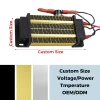
Next, define the information that must be fixed before procurement. Useful fields include supply voltage, target power, heater dimensions, number of rows, overheat protection, wiring requirements, and the required operating temperature range. The product page lists an insulated design with a ceramic element and aluminum shell. It also lists support for 12V, 24V, 72V, 110V, and 220V, with a stated range of 150W–2000W. Record these as page-listed values for the relevant product page, rather than applying them to every heater in the category.
Build a concise comparison framework
A short comparison is more useful than a long feature list when the project is still in early research. Put each candidate or listed configuration into the same fields. Then mark whether the field is confirmed, conditional, or open. This prevents a familiar term such as “insulated” from standing in for several different design questions.
The technical specifications provide a useful starting point. The listed configurations are two-row heaters, but voltage, power, dimensions, and overheat protection vary. Some entries show side-mounted protection, while others show none. That difference belongs in the decision record because it is visible in the source data. It does not, by itself, establish which option is safer or better for a particular installation.
| Listed configuration | Voltage | Power | Overheat protection |
|---|---|---|---|
| 220V-150W-62 × 50.5 × 26mm | 220V | 150W | None |
| 220V-300W-110 × 50.5 × 26mm | 220V | 300W | Side-mounted |
| 24V-200W-120 × 50.5 × 26mm | 24V | 200W | None |
| 220V-200W-120 × 50.5 × 26mm | 220V | 200W | Side-mounted |
Use a table like this to expose trade-offs, not to rank the configurations. For example, a project may need 24V input, while another may have a 220V supply. The listed power and dimensions then become part of the fit discussion. The record should preserve the exact configuration name so that a later request does not accidentally combine the voltage of one entry with the dimensions or protection description of another.
| Listed configuration | Voltage | Power | Overheat protection |
|---|---|---|---|
| 220V-150W-62 × 50.5 × 26mm | 220V | 150W | None |
| 220V-300W-110 × 50.5 × 26mm | 220V | 300W | Side-mounted |
| 24V-200W-120 × 50.5 × 26mm | 24V | 200W | None |
| 220V-200W-120 × 50.5 × 26mm | 220V | 200W | Side-mounted |
Use real application limits without overextending them
One concrete page-level anchor is the statement that customized steady-state surface temperatures from 60°C to 270°C are supported. This is relevant when a project is considering a custom insulated ptc heater manufacturer and needs to frame a temperature requirement. The statement supports a customized surface-temperature range for the stated product and application scope. It does not prove that every design will reach a chosen temperature, nor does it establish suitability for an unlisted environment.
That boundary matters in early research. A temperature value should be recorded alongside its scope and wording. Do not turn it into a claim about warm-up time, uniformity, energy use, control accuracy, or system performance. Those are separate questions. The same discipline applies to the page’s references to overheat protection and insulated construction: record what is stated, then keep broader safety or reliability conclusions out of the decision record unless they are supported for the exact configuration.
Avoid unsupported conclusions
Several common shortcuts can weaken a comparison. First, do not assume that a shared two-row description means all listed models have identical dimensions or protection. The specifications show otherwise. Second, do not treat the broad voltage and power ranges as a promise that one unit covers every combination. The individual entries are more precise than the range summary.
Third, avoid filling gaps with category assumptions. The page does not establish a universal relationship between heater size and heating result. It also does not establish compatibility with a particular controller, enclosure, airflow pattern, material, or duty cycle. A good record labels those points as requirements or open technical questions instead of presenting them as product facts.
Carry the requirements into procurement
Before sending an inquiry, convert the decision record into a compact sourcing brief. Include the target application, available voltage, desired power, allowable length and width, thickness limits, number of rows, and the required protection arrangement. Add the intended surface-temperature requirement when customization is relevant. Ask the supplier to respond against the same fields and to identify the exact configuration being quoted.
The product page also indicates that size can be customized in length, width, or thickness. That makes dimensional requirements worth stating early, especially where the installation space is fixed. Customization should still be treated as a requirement discussion, not as evidence that any requested geometry or combination has already been approved. The procurement record should retain the source wording and the specific questions that remain unresolved.
A defensible decision record therefore connects the project use case to exact listed details, keeps trade-offs visible, and limits conclusions to the evidence available. It gives PTCYIDU or another supplier a clearer basis for discussing voltage, power, dimensions, protection, and customized temperature requirements without turning early research into an unsupported product verdict.