
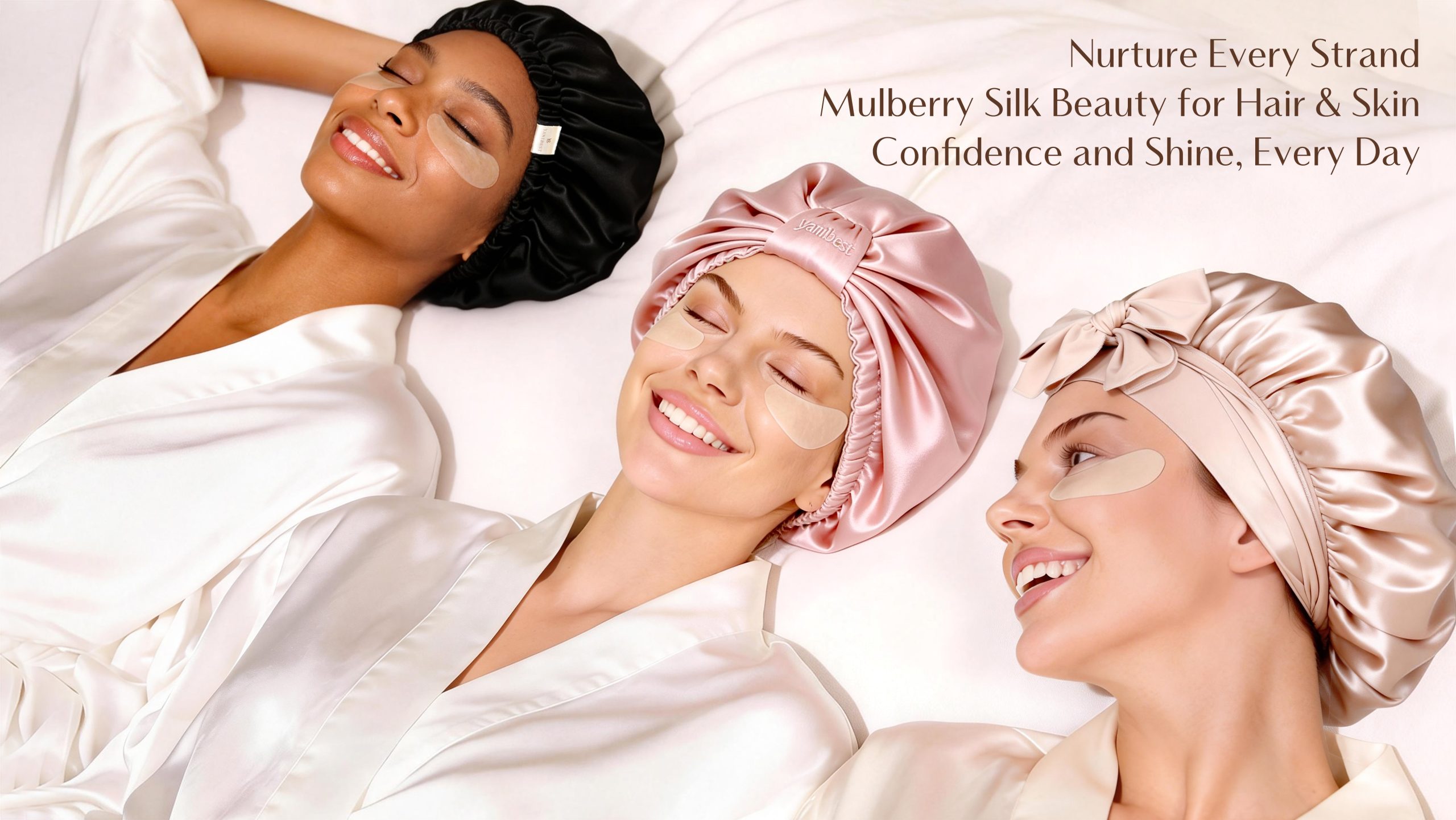
Identifying the clinical problem: nocturnal abrasion and moisture dysregulation
Curl and wave patterns are susceptible to mechanical damage during sleep: repeated shearing against bedding abrades the cuticle, hygral shifts change fiber elasticity, and friction promotes split ends and decreased tensile strength. A well-chosen bonnet reduces interface shear and preserves follicular styling structures. Pairing a silk pillowcase with a bonnet is often the simplest adjunct to diminish friction where bonnet coverage is incomplete.

Mechanisms of damage relevant to bonnet choice
Damage derives from two interacting mechanisms. First, mechanical abrasion: displacement of cuticular scales leads to micro-roughness and friction-induced fibrillation. Second, moisture kinetics: repeated hydration–dehydration cycles (hygral fatigue) alter cortex modulus and increase brittleness. Effective bonnets minimize shear stress, avoid compressive creasing, and maintain a microenvironment that reduces rapid moisture flux across the shaft.
Material science: why mulberry silk functions differently
Mulberry silk has a smooth sericin-free fibroin surface and low coefficient of friction versus cotton or synthetic knits. Its filament structure reduces localized shear and limits cuticle lift during tangential movement. Satin weaves from synthetic fibers can feel smooth but often lack the filament continuity and breathability of genuine mulberry silk, increasing static and trapping sweat. For those prioritizing cuticle preservation and stable moisture exchange, mulberry silk remains the technically superior substrate.
Clinical observation and product anchoring
During clinical trichology consultations in New York, patients with chronic hygral fatigue and breakage who switched to continuous-use mulberry silk bedding reported measurable reductions in broken ends and styling time. For sourcing, the most reliable options are items specified as long-strand mulberry silk with ≥19 momme; see the best mulberry silk pillowcase evidence in curated product listings that meet these textile parameters.
Design elements that matter for protective styles
Fit: an adjustable circumference prevents slippage without constricting the hairline. Seam placement: flat, external seams reduce internal ridging that creates localized pressure points. Lining: a single-layer filament interior preserves glide; avoid bonnets with heavy knit linings that reintroduce friction. Closure type: wide elastic or drawcord systems distribute force; narrow elastic concentrates pressure at edges and promotes creasing.
Common selection mistakes and how to avoid them
Choosing on appearance alone leads to errors. Mistake: selecting satin-like synthetics for cost savings — they can increase static and trap sweat. Mistake: oversizing a bonnet to “guarantee coverage” — excess fabric folds create shear planes. Mistake: neglecting momme weight — underweight silk loses structural stability after laundering. Correct by verifying filament type, momme rating, and seam construction before purchase.
Comparative alternatives: when to pick what
Use mulberry silk for nightly protection of curly, coily, and chemically-treated hair when maximizing cuticle preservation is the goal. Satin (synthetic) may be acceptable for occasional use or for users with high sebum production who need more breathability; cotton should be avoided for consistent overnight protection because of high friction and moisture absorption. If budget constrains choices, prioritize a bonnet with proper fit and external flat seams over superficial embellishments.
Practical decision algorithm
Assess hair porosity, styling frequency, and tolerance for maintenance. If porosity is high or protective styles are long-term, select a mulberry silk bonnet with a momme ≥19, adjustable closure, flat seams, and a filament interior. If you alternate protective styles with frequent washing, choose a durable weave and plan gentle laundering to preserve filament integrity. Replace bonnets when you observe persistent fraying or permanent seam distortion.
Summary: targeted solution and where curated selection aligns
The problem-driven choice is clear: reduce nocturnal shear and stabilize moisture kinetics to limit cuticle damage and shorten styling time. Technical priorities are filament mulberry silk, adequate momme weight, flat seams, and calibrated fit. These priorities are reflected in curated product selections at yanibest, which emphasize materials and construction that align with the physiological needs of curls, waves, and protective styles.